The 2027 Grant Cycle Begins During the 2026 Municipal Budget Process
Pennsylvania’s 2027 Grant Cycle Has Already Started: What Municipalities Should Be Doing Now
September is sometimes called “the great lock-in”—the point when summer ends and organizations turn their attention to budgets, priorities, and the year ahead.
For municipalities, however, September should not mark the beginning of the 2027 budget process.
Ideally, that work began in June 2026, with early conversations about capital needs, operational pressures, community priorities, and projects requiring outside funding. By September, municipalities should already be refining those priorities and developing preliminary costs.
If your municipality is only beginning now, you are behind the eight ball—but it is not too late to establish a disciplined process.
The decisions made during the next several months will determine more than what appears in the 2027 budget. They will determine whether priority projects are positioned to compete for grant funding or whether the municipality will find itself reacting after an opportunity is announced.
A Grant Opportunity Is Not a Funding Strategy

Municipalities often treat budgeting and grant seeking as separate activities.
The budget is adopted during the fall. Later, a grant announcement appears, and officials begin looking for a project that might fit the program.
That reverses the process.
A grant opportunity should not determine a municipality’s priorities. The municipality should first identify its needs, select its priorities, and develop its projects. It can then pursue funding opportunities that align with those decisions.
By the time a grant opens, there may be only a few weeks to apply. That is not enough time to begin defining the project, estimating its cost, securing governing-body support, identifying matching funds, or commissioning necessary engineering.
Competitive applications may require:
A clearly defined scope
A credible cost estimate
Preliminary engineering or design
Evidence of community need
Matching funds
Municipal resolutions
Partner commitments
A realistic implementation schedule
Those elements cannot always be produced on demand. They must be developed through the municipality’s budget and capital-planning processes.
Turn Budget Requests Into a Project Pipeline
The budget process should do more than balance projected revenues and expenses. It should create a pipeline of projects that the municipality can evaluate, prioritize, and prepare for funding.
Every department, committee, authority, emergency-services organization, and community partner should be asked to provide:
A project title and description
The need being addressed
A preliminary cost estimate
The expected timeline
Funding already committed
The connection to municipal priorities
Potential partners
Engineering, permitting, or planning requirements
Possible local-match needs
Not every request will be ready for a 2027 grant. Some projects may be ready for construction funding, while others require a feasibility study, engineering, public engagement, or property control first.
Identifying each project’s actual stage is part of responsible grant planning.
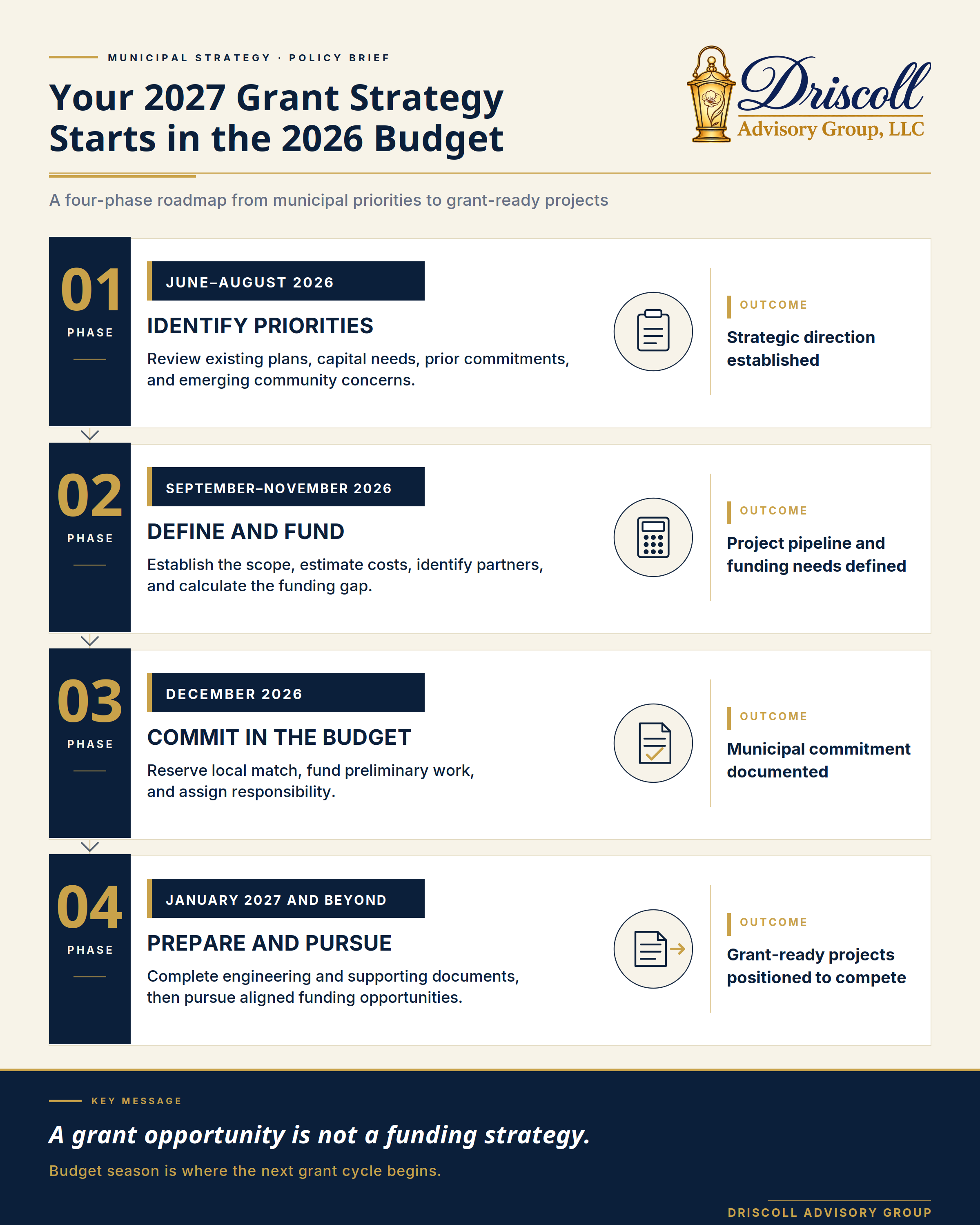
The Municipal Budget-to-Grant Timeline
June–August 2026
Municipal budget activity: Review existing plans, commitments, capital needs, and emerging priorities.
Grant-strategy result: Establish the municipality’s strategic direction.
September–October 2026
Municipal budget activity: Collect project requests from departments, committees, authorities, emergency-services organizations, and community partners.
Grant-strategy result: Create a preliminary project pipeline.
October 2026
Municipal budget activity: Review operating and capital needs.
Grant-strategy result: Define each project’s scope, cost, beneficiaries, ownership, and current stage.
November 2026
Municipal budget activity: Evaluate anticipated revenues, affordability, and existing commitments.
Grant-strategy result: Identify funding gaps, potential matching funds, and remaining readiness needs.
December 2026
Municipal budget activity: Adopt the 2027 operating and capital budgets.
Grant-strategy result: Document municipal commitment and fund necessary preparatory work.
January–March 2027
Municipal budget activity: Advance approved priority projects.
Grant-strategy result: Complete estimates, engineering, partnerships, resolutions, and supporting documents.
Throughout 2027
Municipal budget activity: Monitor relevant funding programs and adjust the capital plan as circumstances change.
Grant-strategy result: Apply when the right funding opportunities open.
Budget season is not separate from grant season. It is where the next grant cycle begins.
Put Grant Readiness Into the Budget
A municipality may not be able to fund an entire project. That is often why outside funding is necessary.
The adopted budget should, however, demonstrate what the municipality is prepared to do next. This could include:
Reserving money for a potential grant match
Funding preliminary engineering or design
Authorizing a feasibility study
Establishing a capital-project line
Budgeting for grant administration and compliance
Assigning responsibility for advancing the project
Even a limited local allocation can demonstrate commitment and provide the resources needed to turn an idea into an application-ready project.
Municipalities should also understand the programs they may pursue. Funding opportunities for transportation, parks, stormwater, water and sewer infrastructure, public safety, emergency services, and community development operate on different schedules and carry different requirements.
To support that initial review, download DAG’s Popular Pennsylvania Municipal Grants: A 2027 Planning Guide—a practical reference to commonly used programs that municipalities may want to monitor as they develop their project pipelines.
Specific programs, appropriations, deadlines, eligibility rules, and funding levels can change. Each opportunity should be monitored and verified before a municipality makes a funding decision. Available grant programs should inform the municipality’s strategy, but they should not replace its own priority-setting process.
If You Are Starting Now, Take Five Steps
If your municipality did not begin planning in June, use September to regain ground:
Request priority operating and capital needs from every responsible party.
Separate routine expenses from potential grant-funded projects.
Identify each project’s owner, estimated cost, current stage, and next requirement.
Determine which projects need local matching funds, engineering, studies, sponsorship, property control, or partnerships.
Connect budget decisions to a 2027 project-development and grant calendar.
The municipalities best positioned for 2027 funding will not necessarily be those that react fastest when a grant is announced. They will be the ones that used the 2026 budget process to define their needs, establish priorities, reserve resources, and prepare credible projects.
A grant opportunity is not a funding strategy.
The strategy begins months earlier—when municipal leaders decide what matters, what it will take, and what they are prepared to do to move it forward.
Begin Building Your 2027 Funding Strategy
Driscoll Advisory Group helps municipalities connect budget priorities, capital needs, and long-term plans to practical funding strategies.
For municipalities beginning now, the first step is a structured review of proposed projects, existing commitments, funding gaps, and grant-readiness needs.
Download DAG’s Popular Pennsylvania Municipal Grants: A 2027 Planning Guide to begin identifying programs that may align with your municipality’s 2027 project pipeline.


Comments